
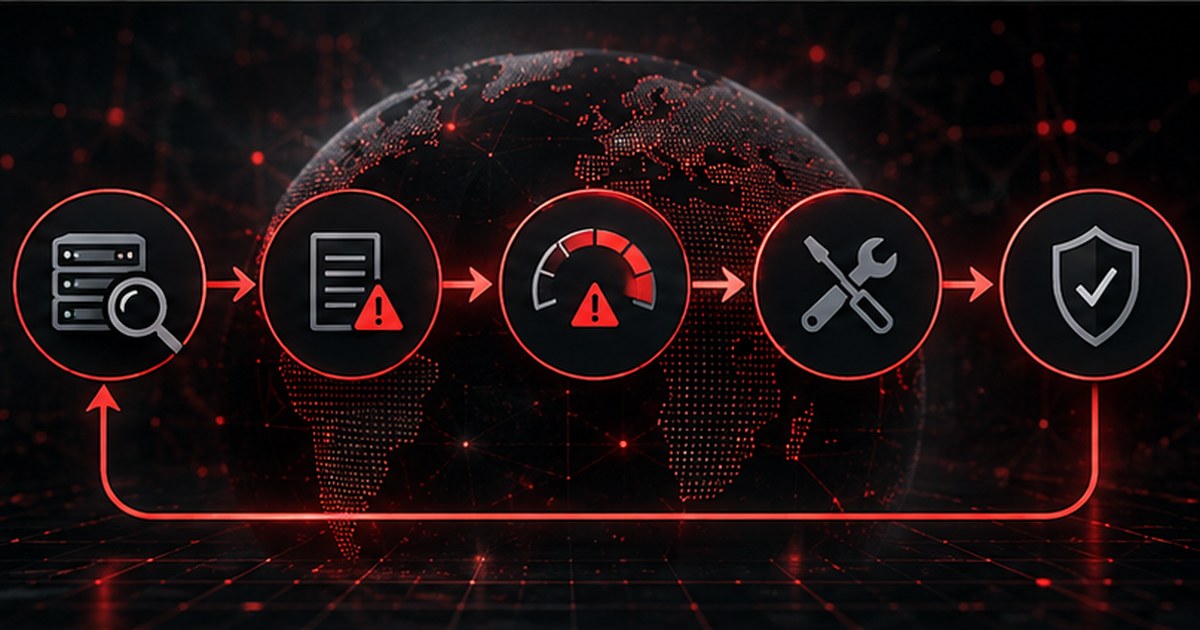
Vulnerability management and Cyber Essentials Plus are not the same thing, but they reinforce each other. Cyber Essentials Plus independently tests whether the Cyber Essentials controls are working in practice. A mature vulnerability-management process helps an organisation find weaknesses earlier, assign remediation and maintain a more consistent security position across the environment.
What vulnerability management actually does
Vulnerability management is an ongoing process rather than a one-off scan. It combines asset visibility, vulnerability identification, prioritisation, remediation, validation and reporting.
Scanning is only one part of that cycle. A useful programme should help answer four questions: what is affected, how serious is it, who owns the fix and how do we know the remediation has worked?
Why it matters for Cyber Essentials
Security update management is one of the five Cyber Essentials technical controls. Under the current NCSC version 3.3 requirements, in-scope software must be licensed and supported. Security updates must be applied within 14 days of release where the update fixes vulnerabilities described by the vendor as critical or high risk, addresses vulnerabilities with a CVSS v3 base score of 7 or above, or the vendor does not provide severity information for the vulnerabilities fixed.
That requirement is much easier to manage when the organisation has a current view of its software and vulnerabilities rather than discovering problems immediately before assessment.
The April 2026 changes make consistency more important
IASME strengthened the 2026 assessment approach around timely security updates. The questions covering high-risk and critical updates for operating systems, router and firewall firmware, and applications became automatic-fail questions for assessments created under the new scheme version.
Cyber Essentials Plus also places greater emphasis on consistent remediation across the wider scope. Where update-management testing fails and a retest is required, the process can include a new random sample as well as the original sample. The practical message is simple: updating only the devices likely to be tested is not a sustainable readiness strategy.
How vulnerability management improves readiness
A well-run programme supports Cyber Essentials Plus in several practical ways:
- Asset visibility: it helps identify systems and software that may otherwise be missed during scoping and readiness work.
- Update prioritisation: findings can be mapped to vendor severity and CVSS information so that remediation deadlines are visible.
- Ownership: vulnerabilities can be assigned to the teams that control the affected systems rather than remaining as an unowned scan report.
- Validation: rescanning or technical verification can confirm that fixes have actually removed the exposure.
- Trend reporting: management can see recurring weaknesses, overdue remediation and areas where the same issue repeatedly returns.
A scanner is not a vulnerability-management programme
Automated scanners are valuable, but they produce findings that still need context. False positives, duplicated findings, compensating controls, vendor limitations and asset ownership all affect the remediation decision.
The goal is therefore not to generate the largest possible list of vulnerabilities. It is to maintain a defensible process that identifies relevant issues, prioritises them accurately and drives them through to closure.
Readiness without the 'mock audit'
Before Cyber Essentials Plus, targeted readiness checks can be useful. These should not be framed as trying to predict or rehearse a particular sample. Instead, they should test whether update management, configuration and remediation are operating consistently across the declared scope.
That approach improves both certification readiness and the underlying security posture. It also reduces the chance that a technical assessment simply discovers issues the organisation could have identified and fixed earlier.
Beyond certification
Vulnerability management has value long after a Cyber Essentials Plus assessment has finished. New vulnerabilities appear continuously, software changes and assets move in and out of service. An ongoing process helps the organisation maintain the security discipline that certification is intended to demonstrate at a point in time.